

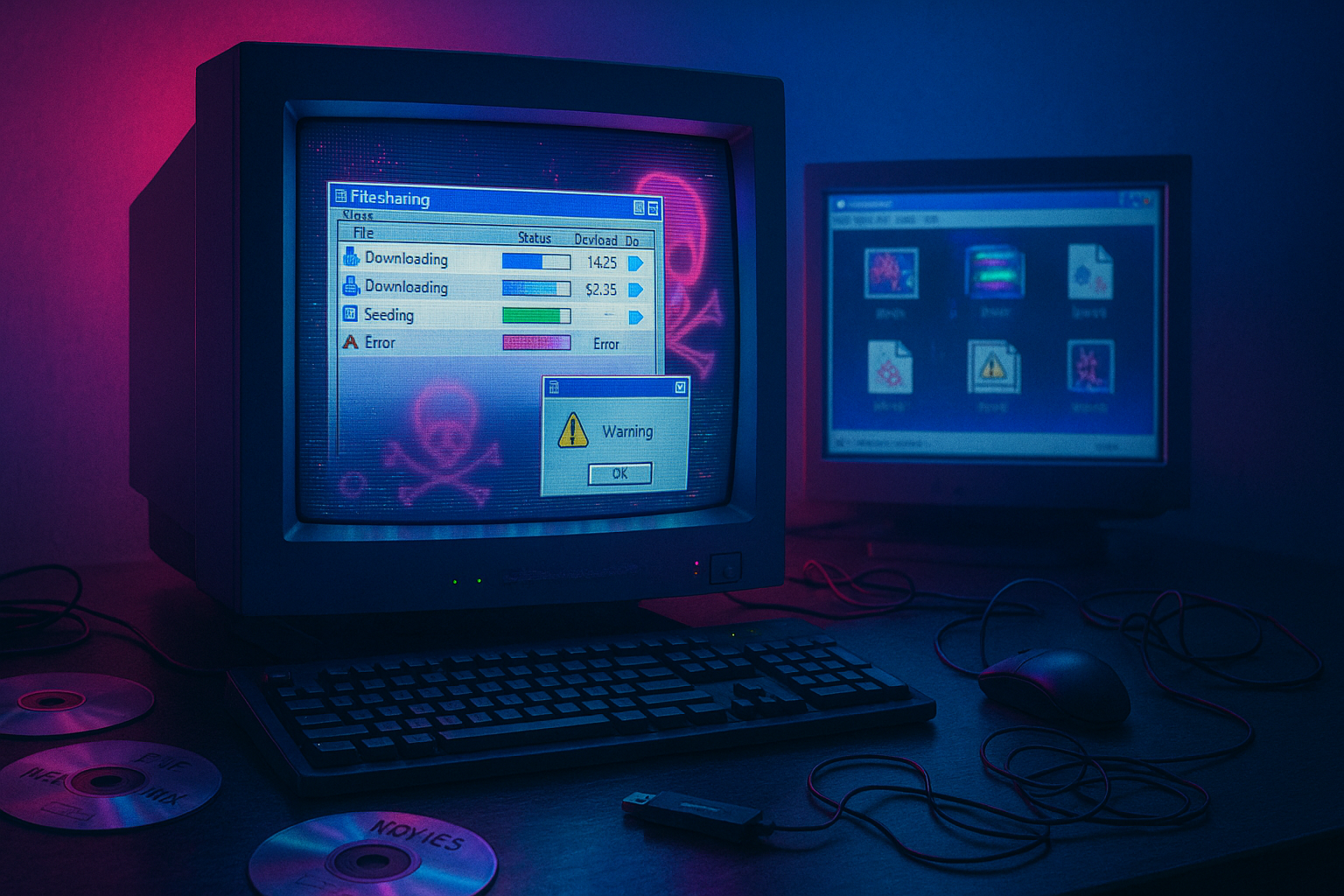
I think it’s an interesting day when you open your computer, start writing, and begin with the phrase “piracy feels good”. It’s a topic that has lived only in the realm of taboo for the past 20 years since digital piracy began to shift from the dark corners of the web to the mainstream. But the plates have been shifting and piracy has emerged into the light. Not as a shaky, uncertain foal – but as a well-polished, ready-to-compete platform contender.
If you remember the early days of the internet, you may recall the hum of a dial up connection, waiting five minutes to load up Yahoo, or perhaps you’ll recall the large, bulky units that couldn’t seem further from what we consider a computer today. But ever since the beginning, there was another side to the internet – a side that enflamed mix-opinions more than any other pass-time. That side was piracy.
What began with ripped CDs and sketchy cracks of popular software, grew into torrent swarms, distributed computing, and new protocols designed to protect those that needed protecting. Digital piracy exploded overnight and those with the knowledge and the technical skills flocked it to.
But back in those early days, you needed knowledge and technical skills. These days, you don’t. Now, all it takes is a smart phone, a laptop, or a smart tv, and an internet connection. With those things in hand, you can sail the high seas to your heart’s content. And not just that, you can do it in style. Rickety pirate ships have been swapped out for luxury yachts, and for the first time in forever, it feels good to be a pirate.
Surely it can’t be just that though. There must be a deeper reason why piracy sites saw over 216 billion visits in 2024. There must be a deeper reason why millions of people just to pirate over purchase. There is, and it all circles back to why streaming services gained popularity in the first place.
Before streaming came around, and before piracy grew into the beast that it has today – there were only a handle of ways to consume the media that you wanted to consume. You either needed to purchase them directly, borrow them from a friend, or rent them from a store (looking at you, blockbuster). There was always a transaction – be it monetary or colloquial.
But soon, as the cost of living rose, and the cost of providing services rose alongside, things became expensive, too expensive for indulgence. Even just the cost of seeing a movie in the theatre has risen from ~$6 in 2005 to $16.50 in 2025. That’s a 2.5x increase, without any of the popcorn, drinks, or extras that you definitely want when you’re going to see a movie. What might have costed a family of four ~$40 to go to see a movie (with snacks, drinks, etc.) now costs ~$130.
Gone are the days where consumption is affordable – everything is a luxury now.
cachedthought.com
Similarly, cable TV in 2025 was ~$40 a month, now it’s ~$110 – seeing a trend here? The cost of consumption has bloated so much in the past two decades that the average joe just can’t afford it anymore.
But quietly, lurking in the background, digital piracy was growing. Whilst the figures from the early 2000s piracy visits are hard to come by, what we do have are the reported losses from the big industries. The big media companies reported supposed losses of ~$615 million from 2002 – 2004, whilst in 2025, they reported losses of $75 billion. Now, it’s important to take those number with a pinch of salt – they are, of course, reported by the companies themselves. But the increase and concept speaks for itself.
In 2024, piracy sites saw upwards of ~216 billion visits – that’s around twenty-seven visits for every person on Earth. Now, out of those ~8 billion people, let’s say that 2 billion are under 14, and 2 billion are over 55 – two categories that aren’t tech-savvy and generally won’t engage in digital piracy. That changes are number from around twenty-seven visits for person to around fifty-four.
Whilst the reasons for this boom are somewhat speculative, we can infer certain things from the figures based on what’s happened in the past – and history has a way of repeating itself time and time again.
People want to pirate – now, more than ever.
cachedthought.com
When digital piracy first came to be, there were no streaming services – no Netflix, no Hulu, no HBO Max. There were DVDs, theatres, and VHS tapes. The two felt worlds apart – one lived in the physical realm, the other virtual. As the internet grew, and more and more companies found their footing online – streaming services emerged. They started out as liberators, saviours that would free the world from the pain of cable/satellite tv. Stream what you want, when you want it, from anywhere in the world. All for the low, low price of $7.99.
That $7.99 subscription in 2010 got you quite a lot – mainstream shows, easy access, people really did feel liberated. Why pay $50 a month for cable when I get everything on-demand for $7.99. People felt like they have a friend in the big companies. That friend would go on to stab them in the back time and time again until it would all get to be too much for the average joe.
Once Netflix proved the model, other companies soon followed. From three major streaming services in 2010, to 200+ in 2025 – there was a requirement for companies to go digital to compete.
But once more and more services came online, they stopped hosting their content on other platforms and started hosting their own. That meant that instead of being able to pick a streaming company and see all your favourite shows and movies, things became fragmented. You could get some of your favourite shows on one, but you needed a second to get the rest. Want to watch that movie you love? Sorry, that’s actually now only available on a third. This went on and on and on.
In 2025, 53% of American households have at least four streaming services and with an average price of $18.99, that’s an eye-watering $75.96 per month for those roughly sixty-nine million households. Think back to why people wanted to leave cable (that $50 per month bill), and now imagine spending 50% more.
Despite the ~$75 bill, users kept getting hit with more and more issues – password sharing crackdowns, content removal, ads – users just couldn’t stand it anymore. And when a collective people see something wrong, they do want people have done for millennia: they rebel. Streaming services would soon come to learn that if you kill the golden goose, all you’ve got is a dead goose.
There’s a new liberator in town: Piracy
cachedthought.com
As piracy evolved from p2p torrent swarms into glossy sites with high-speed streams, and premium UIs, people began to notice. What once needed purpose-built software, only needed a browser. People no longer needed to be tech-savvy or highly-skilled. All they needed was a computer, smart phone, or tv, and a link. It didn’t feel like piracy anymore – it felt like a service.
Much like how Facebook gained popularity or TikTok gained millions of users overnight, mainstream piracy followed all other trends in the technology world. Once one user finds something intriguing, they share it with a friend, who shares it with a friend, who shares it with a friend.


No comments yet